 |
|
 |
|

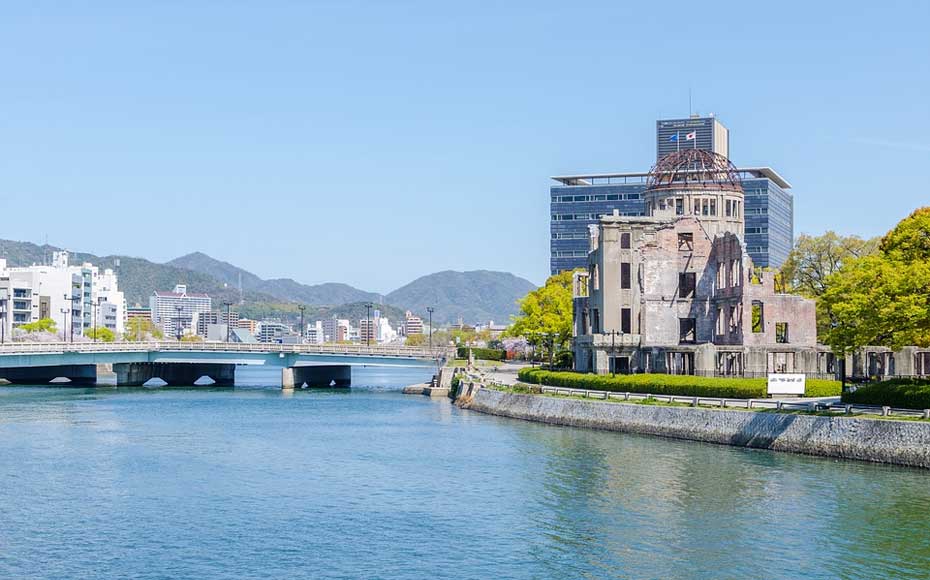
Hiroshima Peace Memorial Museum & Park |
 |
 |
|
This is a real masterpiece of modernism architecture in Japan. It
would be fair to say that the post WWII Japanese architecture started with
this. Here you see some of TANGE's writings from a magazine called SHINKENCHIKU,
or New Architecture, being published when the project was in progress.
The following four issues are discussed:
1. Scale
2. Pray for the Repose or Create Peace
3. Axis of Vista
4. Present Status |
|
|
DATA |
|
Design: TANGE Kenzo + ASADA Takashi + OTANI Sachio
Location: 1 Nakajima-cho, Naka-ku, Hiroshima City
Purpose of Use: Museum
Completed in: 1955
Total Floor Area: 1,615sqm
Structure : RC
map (mapion)
map (Google Map) |
|
|
|
 |
| #1 |
|
The authority requested me to give counsel for war damage reconstruction
immediately after the war. I didn't waste any minute to volunteer for Hiroshima's
rehabilitation. Rumor in those days said even a single weed would not grow
in Hiroshima, but I didn't care and was ready to sacrifice myself. Hiroshima
was where I spent my joyous high school days and the city was plunged into
catastrophe when I lost both my parents almost simultaneously. I felt I
was deeply connected to the city.
(From Kenzo TANGE Associates official web site; original text in Japanese) |
When the war was about to be over, TANGE was informed of his father's
death. He headed for his home in Imabari; on the way, he heard of Hiroshima's
total destruction. He finally got to Imabari, only to find the city air-raided
and reduced to ashes on August 6, the same day Hiroshima was annihilated.
His mother was killed in the air raid. This personal experience made him
attached to Hiroshima. TANGE, a graduate of Hiroshima High School (a public
elite high school under the former school system) advanced into barren
Hiroshima; made reconstruction plans, got involved in the design competitions
for the Memorial Cathedral for World Peace and Peace Memorial Museum. |
|
1. Scale
|
|
|
|

#2 |
|
Before WWII, Hiroshima still retained the townscape from the pre-modern times. The buildings were low-rise and built in human scale. Simply put, Hiroshima used to be just like Kyoto. The war, however, made Hiroshima's Ground Zero a vast barren desert with everything erased from the surface. That was where this huge museum, far beyond human scale, was built. It must have given an incredible impact which we cannot imagine at all.
TANGE loved what Le Corbusier represented and was convinced that
the Japanese architecture would become enormous in scale. He passionately
said that large architecture built in social human scale was in demand
instead of those in human scale. |
|
I was impressed by the Roman architecture built in divine scale when I
witnessed them. I talked to GROPIUS in broken English about the day when
I left Rome for London. He earnestly explained that modern architecture
should be built in human scale. (snip) I, however, had employed the scale
far beyond human scale.
Later I had a chance to visit apartment houses in Marseilles designed by
Le Corbusier. I felt overwhelmed standing under the piloti, which I thought
was created in social human scale. (snip) Then I went back to Japan and
was surprised to find the one-story-house townscape in Maru-no-uchi or
Ginza extraordinary humanlike. The dwarfed rows of houses made me feel
oppressed and suffocated. They looked extremely antisocial and rather pre-modern
to me. (snip) I felt uncertain and went to Hiroshima to see the museum
under construction. I felt relieved that the museum of this scale was consistent
with my intention.
(From a magazine SHINKENCHIKU Jan. 1954; original text in Japanese) |
TANGE Kenzo first went abroad to visit London to present his Hiroshima
project at the CIAM convention. The above account must have written on
that occasion. The Marseilles apartment houses must be the famous Unite
d'Habitation. The piloti of the Hiroshima Peace Memorial Museum looks quite
similar to that of Unite d'Habitation.
GROPIUS preached the significance of human scale, while TANGE slashed it
as pre-modern. When he stood at the construction site in Hiroshima again,
he was reassured that he was right. He sure was a pioneer leading the Japanese
architecture beyond human scale. It was true that some vehemently opposed
such a large scale construction when many didn't have a place to live and
were in the depth of extreme poverty. TANGE himself admitted that he was
frustrated by the chasm between ideal and reality.
When I was engaged in the design of the Hiroshima peace facilities, I had an ambition of coordinating the two scales, human scale and social human scale, in one building. I started with the Peace Memorial Museum. Its main structure was built in social human scale, while stairs with a landing and birdcage-like louvers were in human scale. These two scales were meant to interact with each other.
(From a magazine SHINKENCHIKU Jan. 1954; original text in Japanese) |
The social human scale is the contemporary urban scale with the preposition
of skyscrapers and auto traffic, where humans are tiny in size. Meanwhile,
the human scale is within the range of what people actually lay a hand
on. TANGE says the museum and piloti are in social human scale; the landing
in human scale. (photo #2)
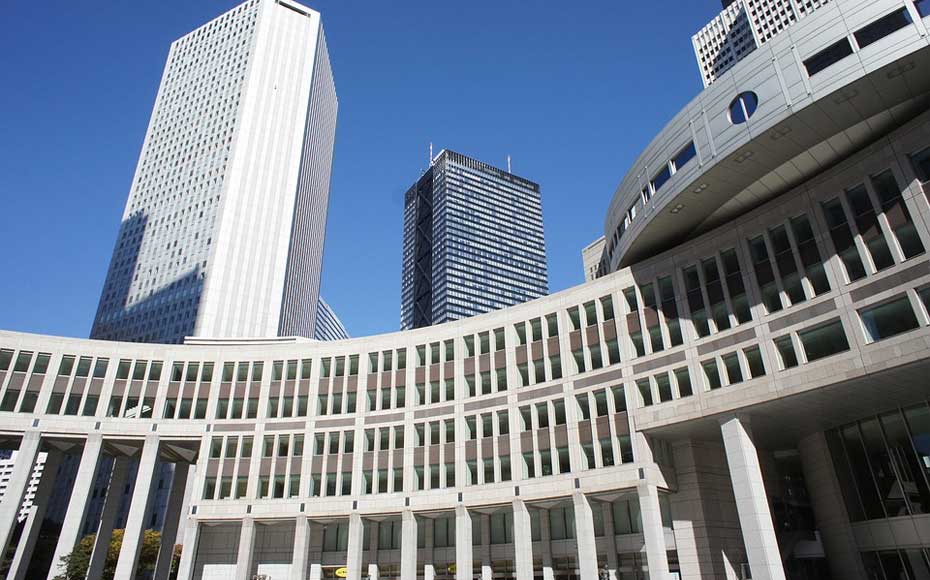
TANGE, reputed by the Hiroshima project, embarked on building huge architecture one after another. The supposed culmination of such projects, the Tokyo Metropolitan Government Building, only shows glaring flaws resulting from ignoring human scale and not a masterpiece at all. |
|
2. Pray for the Repose or Create Peace
|
|
All the Hiroshima City mayors have independently been active in diplomacy
and often advocated opinions different from those of the Japanese government.
The mayors' standpoints will be ignored after all but create a certain
impact on the world.
If you insist on an eternal peace principle of no more wars, it would be destined to internationalism and sister and brotherhood. There, nation, race, or religion would not be significant at all. TANGE Kenzo didn't incorporate any direct element that would be directly associated with Japan. He referred to Le Corbusier and adopted the international style which did not belong anywhere but was universal for all human beings. |
|

#3: The Earthquake Memorial in Tokyo was designed by ITO Chuta. |
|
There seems to have been some argument in those days. Try reading
the following excerpts.
At that moment, opinions were more inclined to constructing a monument like a peace memorial tower centering a memorial hall. An architect of the UK forces, an advisor of Hiroshima City, constantly insisted on constructing something like a five-storied pagoda. When he came to see me in Tokyo, I took him to the Peace Memorial Tower for the Earthquake Victims in Tokyo. Outraged, I barked at him and said that this was what he and others wanted.
(From a magazine SHINKENCHIKU Jan. 1954; original text in Japanese) |
This architect of the UK forces seems to be Major S.A.JERVIE, an architect
of the Australian forces.
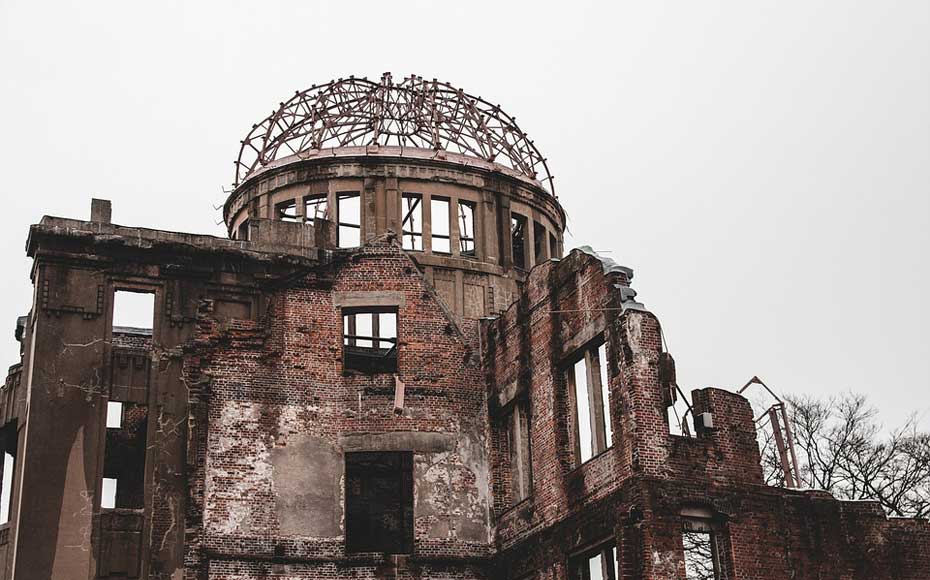
Attention has to be paid to the utter difference in character between the
Earthquake Memorial (photo #3, #4) and the Hiroshima Peace Center. The
first is where you mourn for the victims of the Great Kanto Earthquake
and not where you pray for no more earthquakes. After all, there's no use
praying since earthquakes are natural disasters. On the contrary, the latter
is where you pray for no more wars. War is preventable if you try; it's
not a natural disaster. TANGE asserted, "The purpose of this facility
is not to mourn, but to pray, so a Japanese traditional design like that
of the Earthquake Memorial is inappropriate."
Peace does not come naturally; instead it has to be sought and obtained. Peace is not what Mother Nature or Divinity bestows upon you but you practice and create it. This Hiroshima peace facility is not only for commemorating restored peace but for creating peace in a constructive way. We thought the facility we were about to work on had to be a factory where peace shall be created.
(From a magazine KENCHIKU-ZASSHI, later renamed SHINKENCHIKU Oct. 1949; original text in Japanese) |
|

#4 |
|
|
TANGE didn't mean to eliminate all memorial function; the cenotaph was
to be dedicated in the center of the park. Details about the cenotaph are
discussed in a different page.
I couldn't help wondering in spite of my decision. Because I though it
was significant that people of Hiroshima wanted to have a commemorative
tower including a memorial hall. I felt there should be a place, even though
humble, where people mourn for the sacrifice of their fathers, mothers,
wives and children and pay homage to them.
(From a magazine SHINKENCHIKU Jan. 1954; original text in Japanese) |
|
|
3. Axis of Vista
|
|

#5:Nakajima Area before the A-bombing
Before the A-bombing, Hiroshima was built in conventional human scale and the Nakajima area was downtown. The Industrial Promotion Hall (A), Aioi-bashi bridge, an intended target of the A-bombing (B), Honkawa Elementary School (C), and Fuel Hall (D) are seen. |

#6:Layout of Peace Memorial Park
Peace Boulevard (a) is perpendicular to the line which connects the Museum
(b), Cenotaph (c), and A-bomb Dome. Additionally, the City Auditorium (d)
was built on the premises. The Fuel Hall (e) was the only remaining building
from the former Nakajima area. |
|
|
|
Hiroshima City decided to develop the Nakajima area, near Ground Zero,
as a park and held a design competition in 1949. The targeted area was
the Nakajima delta and the A-bomb Dome environs. The park and museum had
to be designed. As a result, TANGE Kenzo was awarded the first place; YAMASHITA
Toshiro, the second; ARAI Ryuzo, the third. TANGE employed the axis which
is at right angle with Peace Boulevard (100-meter Boulevard) and reaches
the A-bomb Dome. He planned the cenotaph on the axis and the museum, or
gate to the park, at one end of the axis near Peace Boulevard (photo #5).
The museum is raised by piloti, enabling you to see the A-bomb Dome through
it. The piloti, excellent in its aesthetic design, plays its practical
role as well: the axis on the ground runs straight without obstruction.
No other piloti would have such a clear-cut and important role.
|
|
|

#7: The Cenotaph and the A-bomb Dome are aligned, seen through the piloti. |
|

#8 |
|

#9 |

#10: Around the Cenotaph is a pool to keep the space vacant between the
Cenotaph and the Dome. |
|
|
Let us look at other plans as well. YAMASHITA won the second place. The
axis is directed to the east, the park itself pursues its beauty, and the
park and the city is not linked in any way. Arai came in third. His axis
aims at the apex of the delta and the A-bomb Dome doesn't stand on the
extension of the axis. There should be no correct answers in architectural
design but TANGE's plan looks correct and the others look wrong.
|

#11: Bird's eye view of Peace Park, seen from the A-bomb Dome area.
(C) Hiroshima Convention and Visitors Bureau |
|
|
|
 |
|
|
Following is the interview to TANGE by architecture critics FUJIMORI Terunobu and MATSUBA Kazukiyo about how TANGE's plan developed.
| FUJIMORI & MATSUBA: |
What is remarkable about your plan is the conception of the axis at right angle with Peace Boulevard to integrate the A-bomb Dome in the layout. Do you remember how you came up with the idea? |
| TANGE: |
I don't remember well. From the urban development point of view, the 100-meter
Boulevard was a clue. The street which crosses at 45-degree angle with
the delta used to be a busy street and I wanted to leave it as a traffic
route. Besides the two bridges leading to either end of Peace Boulevard,
there are still three bridges creating important traffic routes. How to
link them together was difficult. I didn't figure out how to deal with
the A-bomb Dome quickly. But finally, I thought of the axis perpendicular
to the 100-meter Boulevard. It took a lot of time. Not an idea I had had
from the beginning. |
| FUJIMORI & MATSUBA: |
Did you think of several plans? |
| TANGE: |
I didn't have several plans at the same time. I thought of any possibilities at random, then at one time I came to an conclusion. I like this form. |
| FUJIMORI & MATSUBA: |
You mean this layout of traffic routes created by combining two trapezoids in a hand drum shape. |
| TANGE: |
I also adopted this idea for the competition held during the war. This hand drum shape works as a network of the site and creates the center as well. I gradually realized that. Then I thought if this center and the Dome were connected, the connected line would be perpendicular to the 100-meter Boulevard. When I came upon with this hand drum shape, I felt something was forming. Then the main approach had to be here. People should visit the park from a gate. Then I would make the museum itself a gate and the museum was raised by piloti. |
| FUJIMORI & MATSUBA: |
So first from the city planning aspect such as laying traffic routes, then to respective buildings. |
| TANGE: |
Yes. |
(From a book TANGE KENZO written by TANGE Kenzo & FUJIMORI Terunobu; original text in Japanese) |
|
|
|
|
| TANGE knew the pre-war Hiroshima well, so he tried to leave this road no
matter what. He started with this road, the road coming down from Aioi-bashi
bridge (T-shaped), the 100-meter Boulevard, and the A-bomb Dome (above
graphic, phase 1). He laid routes in a hand drum outline on the delta
(phase 2). Then he saw an axis stretching from the 100-meter Boulevard
to the Dome at right angle (phase 3). This axis was first determined, then
the other necessary buildings were laid out to finish the plan (phase 4). |
|
4. Present Status
|
|

#12: The piloti works as a gate. |
|
Hiroshima City made it a rule to continue using this building as much as possible by maintaining it properly. Most of the Japanese modernism architectures built mainly in 1950s were demolished, but this building, pioneering all other modernism architectures, is still at work. The best way to know the real value of Peace Park is to attend the Peace Memorial Ceremony on August 6. The park is usually quiet, but this day attracts a variety of political or religious organizations and artists. The park is permeated with some special atmosphere.
The issue here is the aging survivors. That is, in near future, there will be no one who directly experienced the A-bombing. Then people will come to Peace Park not to pay homage to the deceased but to pray for peace in the future. To cope with this remarkable shift, the function that TANGE originally aimed for, the factory where peace shall be created, should be strengthened. For example, world-scale events, art exhibitions or installations, and so forth can be held at Peace Park. The park should be where messages are heard and spread. |

#13: Peace Memorial Ceremony on the morning of August 6. |

#14 |
|
|

#15: Lantern floating is seen on the evening of August 6. First it was
held to pray for the deceased but now rather to send out messages of peace. |
|
|
|
|
[Footnote]
*The road is 100 meter wide. It was built according to the reconstruction plan.
[Access]
 |
[TRAM] 10 minutes on foot from Hiroden Genbaku-Dome-Mae or Fukuro-Machi. |
 |
[BUS] Take #25 Red Bus and get off at Heiwa-Kinen-Koen (Peace Memorial Park). |
Map download is here.
[For Visitors]
Hiroshima Peace Memorial Museum http://www.pcf.city.hiroshima.jp/
Hours: 8:30 - 16:30 (or 17:30) Admission until 18:30 in August
Admission: 50 yen for adults |
|
 |
Created on Mar. 22, 2000 Last updated on Jul. 4, 2008 Written by makoto Translated by jasmine Photos taken by makoto Camera: NikonD70 & Canon PowerShot G1 |
| Photos on this page are licensed under a Creative Commons License. You are free to copy and make commercial use of them under the conditions
"Attribution" and "No Derivative Works". [about copyright] |
|
|
|
|
|
PEACE CENTER INDEX |
|
|
|
| (CC) arch-hiroshima 2006 |
|
 |
|
|
|
|